
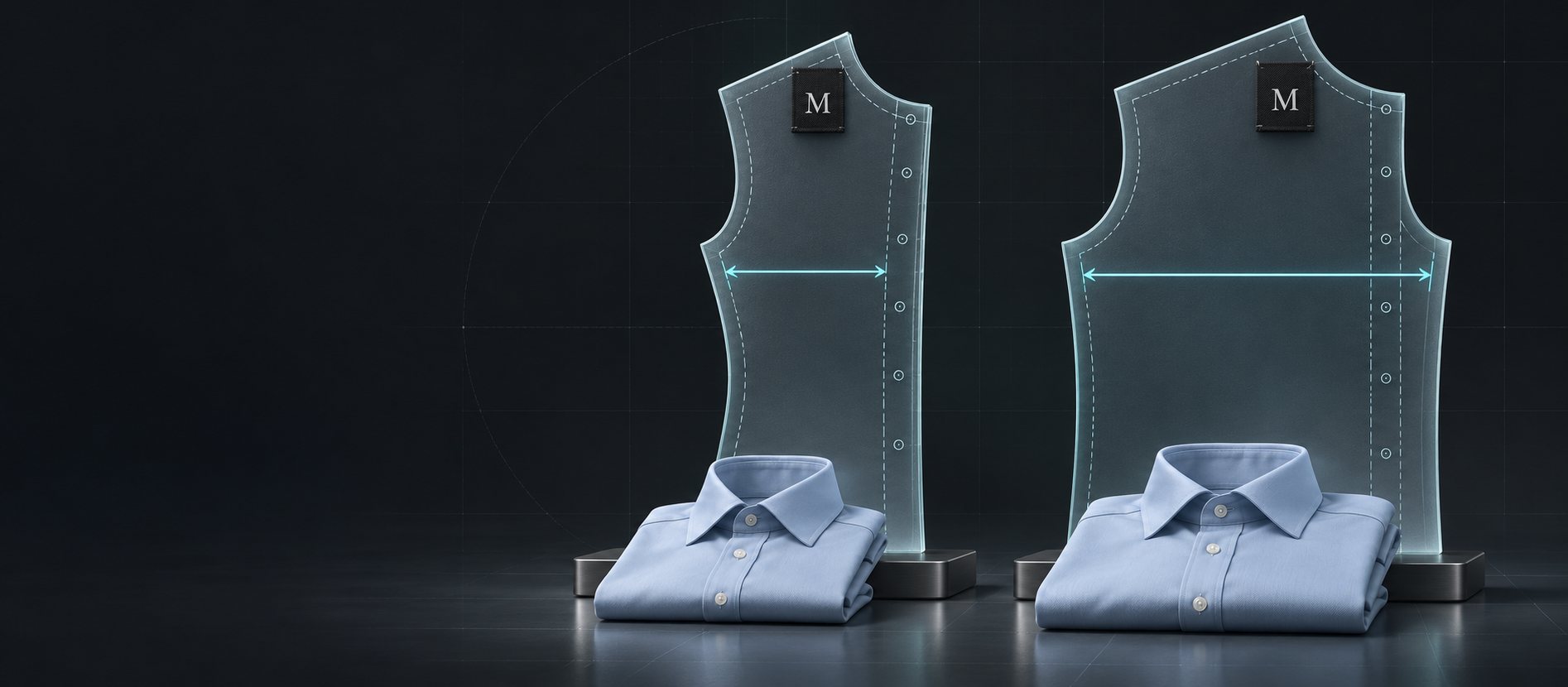
Same label, different garment
Two garments with the same size label may have very different measurements, as one of Europe's largest online fashion retailers puts it.
Most of us have a size we think of as "ours". We type it into a filter, pick it from a drop-down and expect the parcel to fit. Then a pair of jeans arrives that is tight at the waist, while the same size from another label hangs loose. Nothing went wrong in the warehouse. The label simply did not mean what we thought it meant.
A size is a name, not a measurement
Size labels look like measurements, but they are closer to names. A brand chooses a reference body, drafts a pattern around it and then grades that pattern up and down into a range. Each step involves choices: how much room to leave at the chest, how long the sleeve should be, whether the cut is meant to sit close or relaxed. Two brands can make different, equally reasonable choices and still print the same letter or number on the label.
Even within one company, sizes drift. A new factory, a new fabric with more or less stretch, or a different fit intent for the season can move the real dimensions of a garment while the label stays the same.
Zalando, one of Europe's largest online fashion retailers, describes the problem plainly: two garments with the same size label may have very different measurements (Zalando corporate, How Zalando uses technology to help customers find the right size, Jun 22, 2026). That is a retailer with a deep view of its own return data saying what many shoppers already suspect.
Why it matters more online
In a shop, the gap between label and garment is closed in the fitting room. You try the size, then the next one, and leave with whatever fits. Online, that fitting room moves to your bedroom, and it runs on a delay of several days and a return trip.
The cost shows up in the reasons shoppers give for sending things back.
In Rithum's 2025 consumer research, 61% said poor fit was the top reason they returned clothing or shoes (Rithum, 2025 Global Returns & Profit Impact Report, 2025). When the label is unreliable, ordering two sizes and returning one starts to look like common sense rather than bad behaviour. Every one of those extra parcels has to be picked, shipped, inspected and restocked.
What shoppers can do today
Until sizing gets better, a few habits help:
- Read the garment measurements, not only the size. Many product pages list chest, waist, hip or length in centimetres or inches. Compare them with a garment you already own that fits well.
- Check the fit description. "Slim", "regular" and "relaxed" tell you how the brand intends the garment to sit, which changes which size you need.
- Look for fabric details. Stretch fabrics forgive more; rigid denim or linen forgives less.
- Keep notes per brand. If a brand runs small for you, it will usually keep doing so.
These steps work, but they ask a lot of the shopper: a tape measure, a reference garment, and patience on every product page.
Matching the body to the garment
The more useful comparison is not "my size against their size" but "my body against this garment". That is the idea behind VyMetric. You take guided photos with your phone, and your measurements stay encrypted on your phone and are matched to each product's size specs. The label becomes one input among many rather than the whole decision.
Shoppers seem ready for this kind of help. In the same research, 39% said better size and fit recommendations would significantly reduce their returns (Rithum, 2025 Global Returns & Profit Impact Report, 2025). That is not a promise that recommendations remove returns, and we do not claim it. It is a signal that people want a better answer than a letter on a label.
The takeaway
A size label is a useful shorthand, but it was never designed to travel across brands, fabrics and seasons. Treat it as a starting point and check the real garment measurements when you can. If you would rather not do that by hand on every order, join the VyMetric waitlist. Target launch: Q3 2027. If you sell clothing online and want to see how fit matching could work with your size specs, request a presentation.